
Your First 28 Days of Healthier Habits
A day-by-day behavior blueprint for building habits that hold.
Anyone can commit to a change for a day. The real question is what happens on day 12, when the novelty is gone and the old routine starts calling. That's why this guide doesn't give you a diet — it gives you a sequence.
Twenty-eight days, walked one week at a time, building the small behaviors that eventually run on autopilot. Written by Robert Coles, who used this exact sequence on his way from 490 pounds to 184.
Get Instant Access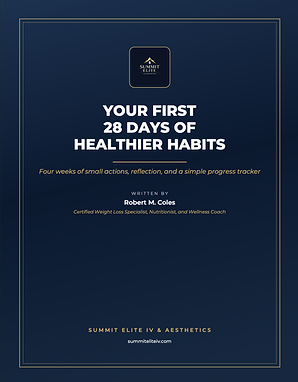
What you'll learn.
Week-by-week habit blueprint — exactly what to focus on, and when
How to design your environment so good habits require less effort
Simple tracking that keeps you honest without becoming obsessive
What to do when you miss a day (and why missing is part of the process)
The 5 habits Robert used to lose 306 pounds — explained step by step
A printable 28-day habit tracker
Get instant access
Enter your email below and we'll send Your First 28 Days of Healthier Habits straight to your inbox — free, no strings attached.
Why 28 days?
Twenty-eight days is long enough for a new behavior to stop feeling foreign and short enough to commit to without dread. But be clear: 28 days is not a magic number, and nothing finishes at the end of it. What it really gives you is a contained window — a complete experiment you can actually finish, review, and learn from.
Most people fail because they never define what "trying" means. With a 28-day window, trying becomes concrete: you started on a date, you tracked what you did, and at the end you have data instead of guesses. That data — not motivation — is what tells you what to keep, what to adjust, and what to run next.
What you'll do each week
Week one is awareness. You don't change anything yet — you observe. What do you actually eat in a day? When do you snack, and why? What does your sleep look like? Most people are surprised how much of their eating happens on autopilot, and week one makes the invisible visible.
Week two builds the foundation habits: hydration, protein at each meal, and a consistent sleep window. Week three adds movement and environment design — a daily walking habit and a kitchen audit that makes the healthy choice the easy one. Week four consolidates: you review your tracker, keep what's working, fix what isn't, and map your next 28 days. Each week builds on the last, so you're never changing more than your foundation can hold.
Habit design: making the healthy choice automatic
Willpower is the worst tool in your kit — it's strongest at 8 AM and gone by dinnertime. Habit design replaces willpower with structure. Lay your workout clothes out the night before and morning movement stops being a decision. Keep the fruit on the counter and the chips out of the house, and snacking improves without a single moment of self-denial.
The guide walks through the three levers of habit design: reducing friction for the habits you want, adding friction to the ones you don't, and anchoring new behaviors to routines you already have. These are the same mechanics that carried a 490-pound man to a half-marathon finish line — and they work just as well on your first glass of water in the morning.
What happens after day 28
Here's the mindset shift that separates people who sustain changes from people who restart every January: the tracker ends, the system doesn't. Day 29 isn't a finish line — it's a review. You keep the habits that earned their place, adjust the ones that need a different shape, and let go of the ones that fought you every day.
Then you run the cycle again. Each 28-day pass makes the routine more yours — less borrowed, more permanent. Six cycles from now, you won't recognize the baseline you started from, and you won't be relying on motivation to stay there.
How this pairs with clinical support
This blueprint is completely free and works entirely on its own. But if you have significant weight to lose, behavior work goes further with a clinical layer behind it — GLP-1 medication when appropriate, provider oversight, and coaching from someone who has lived the full journey. The habits you build in these 28 days are the exact ones that make medical treatment succeed long-term. If you decide you want that support, our team is ready when you are.
Robert Coles
pounds lost — 490 to 184
races completed
BMI — healthy range
Written by Robert Coles, Chief Operations Officer of Summit Elite IV & Aesthetics. Robert lost 306 pounds — from 490 pounds and a BMI of 68.3 down to 184 pounds and a BMI of 25.6 — beginning when his doctors told him he had less than two years to live. A Licensed Clinical Nutritionist, Certified Personal Trainer, and Certified Weight Loss Counselor, he now leads Summit Elite's medical weight management program, where behavior modification — not dieting — is the core method.