
What to Expect From Medically Guided Weight Management
A transparent look at GLP-1s, clinical oversight, and realistic outcomes.
Medical weight management is surrounded by noise — miracle-drug headlines, dramatic before-and-after photos, and warnings that swing the other way. Rarely does anyone simply explain how it works.
This guide is that explanation: a calm, honest walkthrough of what medically guided weight loss looks like from the inside — the clinical process, GLP-1 medications, the first 90 days, and the behavior work that determines whether results last.
Get Instant Access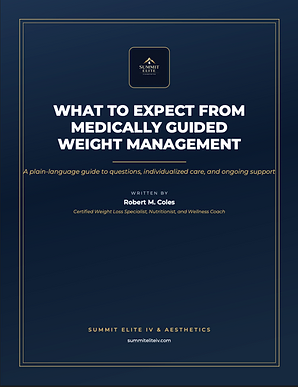
What you'll learn.
What "medically guided" actually means — who does what, and why it matters
How GLP-1 medications work, and who they're appropriate for
What happens at each stage: intake, labs, titration, follow-up
Realistic expectations for pace, plateaus, and outcomes
Why behavior change determines whether results last
The questions to ask any provider before you start
Get instant access
Enter your email below and we'll send What to Expect From Medically Guided Weight Management straight to your inbox — free, no strings attached.
What medically guided actually means
Medically guided weight management is not a medication with a subscription attached. It's a clinical relationship. It begins with a real intake: your health history, current medications, weight history, labs, and an evaluation — often including a Good Faith Exam — to confirm that treatment is appropriate for you. Not everyone is a candidate, and a responsible program will tell you so.
From there, it means oversight: a prescribing clinician who reviews your response, manages your dosing, watches for side effects, and adjusts the plan based on your data rather than your impatience. If a program you're considering skips the evaluation, the labs, or the follow-up, that's not medical guidance — it's a product sale. The difference matters for your safety and your results.
The role of GLP-1 medications
GLP-1 medications act on biological pathways involved in appetite, satiety, and blood-sugar regulation. For eligible patients, they can make it dramatically easier to eat less without feeling constantly deprived — which is why, when clinically appropriate, they've become a cornerstone of modern weight management. Dosing typically starts low and increases gradually, so your body adjusts and side effects stay manageable.
But medication is a tool, not a transformation. It creates a window of opportunity — quieter hunger, easier portion control — and what you build inside that window determines everything that happens after. Common side effects like nausea and digestive changes are real and worth discussing openly with your provider, and serious risks exist with any prescription medication. A good clinician will walk you through all of it before you ever take a dose.
What the first 90 days look like
The first month is about baseline, not results. Intake, eligibility review, labs, your first dose at its lowest level, and the beginning of the habit work — protein, hydration, movement, sleep. The second month is titration and observation: dose increases as tolerated, early trends in your numbers, and the first honest review of what your routines actually look like.
Month three is where patterns emerge. Some weeks the scale cooperates; some it doesn't — and plateaus are a normal part of physiology, not proof of failure. A well-run program treats the 90-day mark as a data review, not a deadline: what's working, what needs adjusting, and what the next 90 days should focus on. Programs that promise a specific number by a specific date are selling you something no one can honestly sell.
The behavior work that makes results last
Here is the part most programs skip: medication changes your appetite, not your behavior. Without deliberate work on habits, environment, and identity, the medication's window closes and the weight returns — the single most common story in long-term weight management. The patients who keep their results are the ones who used the treated months to build an untreated life.
That means protein-forward nutrition to protect muscle, resistance training where appropriate, stress and sleep routines that don't revolve around food, and a maintenance plan agreed with your clinician before you ever reach goal. Our program is led by Robert Coles, who lost 306 pounds with GLP-1s and surgery — and will tell you plainly that the behaviors, not the prescriptions, are what kept it off.
Questions to ask before you start
Before beginning any program, ask: Who evaluates me, and how? What labs are required? Who prescribes and monitors the medication? What happens if I experience side effects? How is dosing escalated? What does the plan look like after I reach my goal? And what proportion of my success is expected to come from medication versus behavior change?
A trustworthy provider welcomes every one of those questions. This guide gives you the full context behind each answer — so you can start your program informed, confident, and with expectations that match reality.
Robert Coles
pounds lost — 490 to 184
races completed
BMI — healthy range
Written by Robert Coles, Chief Operations Officer of Summit Elite IV & Aesthetics. Robert lost 306 pounds — from 490 pounds and a BMI of 68.3 down to 184 pounds and a BMI of 25.6 — beginning when his doctors told him he had less than two years to live. A Licensed Clinical Nutritionist, Certified Personal Trainer, and Certified Weight Loss Counselor, he now leads Summit Elite's medical weight management program, where behavior modification — not dieting — is the core method.