
IV vs. Oral Supplements: The Bioavailability Battle, Explained by an RN
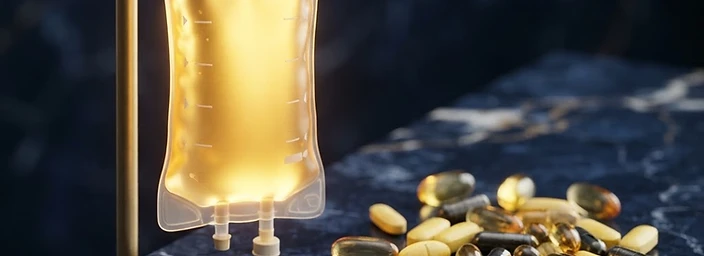
Every week someone asks me some version of the same question: 'If I can buy the same vitamins over the counter for $20, why would I get them intravenously?' It's a fair question, and the answer lives in a single clinical word: bioavailability — the fraction of a dose that actually reaches your bloodstream and becomes available to your cells.
When you swallow a supplement, it faces a brutal commute. Stomach acid degrades part of it. Digestive enzymes break down more. Then comes first-pass metabolism — the liver filters a significant share of what survives before it ever reaches general circulation. The net result, depending on the nutrient, the formulation, and your gut: as little as 20–50% of the label's dose makes it to your cells.
The IV Route Skips the Commute
An intravenous infusion places nutrients directly into the bloodstream. No stomach acid, no enzymes, no liver toll booth. The NIH Office of Dietary Supplements documents how oral vitamin C absorption, for example, is tightly limited at higher doses — while plasma saturation from IV delivery is dramatically higher. With IV therapy, bioavailability is effectively 100%. Same molecule, radically different delivery efficiency.
This is not a fringe idea — PubMed indexes decades of research on intravenous nutrient delivery in clinical settings. What's changed in the last decade is that protocols like the Myers-style drip brought the format from hospital to wellness practice, letting healthy adults use the same pharmacology for maintenance rather than deficiency correction.
Why Oral Supplements Still Matter
None of this makes oral supplements useless — they're a daily baseline, and I take mine. A quality daily regimen covers the routine. Where IV therapy earns its premium is in the gap moments: rapid rehydration after travel, recovery after a hard training block, or nutrient replenishment when depletion is significant. Think of oral supplements as your regular diet and IV therapy as a targeted intervention. For a comparison of how we structure those interventions, our Signature vs. Premium IV tiers map the options by goal.
A Real-World Example
Take the classic Myers Cocktail — magnesium, calcium, B vitamins, and vitamin C in saline. Orally, replicating those doses would mean swallowing handfuls of capsules, most of which never reach your bloodstream in meaningful concentration. Intravenously, the full panel arrives at once, at full strength. That's the difference between hoping a fraction arrives and knowing 100% did.
The Takeaway
The label on a supplement bottle is a promise; bioavailability is what's actually delivered. If you're chasing maintenance, oral supplements are a reasonable floor. If you're chasing a deficit — fluids, recovery, or a hard reset — book a consultation and let the pharmacology do the work. Our Vitamin & Wellness Injections offer a middle path for B12, Vitamin D, and Lipo-B that bypasses the gut at a lower price point than a full drip.
This article is for educational purposes and does not constitute medical advice. Every treatment at Summit Elite follows clinical screening and a Good Faith Exam to confirm candidacy.
Jason Ward, RN
Chief Clinical Officer, Summit Elite IV & AestheticsJason Ward, RN is the co-founder and Chief Clinical Officer of Summit Elite IV & Aesthetics. A registered nurse with deep experience in infusion therapy and clinical operations, he writes about the science behind IV hydration, NAD+ and Niagen therapy, and what safe, concierge care actually looks like.